
Is Mandarin Chinese Hard to Learn? Here Are 5 Reasons It's Not
Ask anyone who has never tried learning Mandarin Chinese and they will almost certainly tell you it is one of the hardest languages in the world. Complex characters, unfamiliar tones, a writing system that looks nothing like any alphabet you have seen before — the reputation is intimidating. But here is the truth: much of that reputation is based on misconceptions rather than reality.
The fact is, Mandarin Chinese has a grammar structure that is in many ways simpler than English, French, Spanish or German. Once you understand why, the language starts to feel a lot less daunting — and a lot more achievable.
Here are 5 reasons why learning Mandarin Chinese is not that hard.
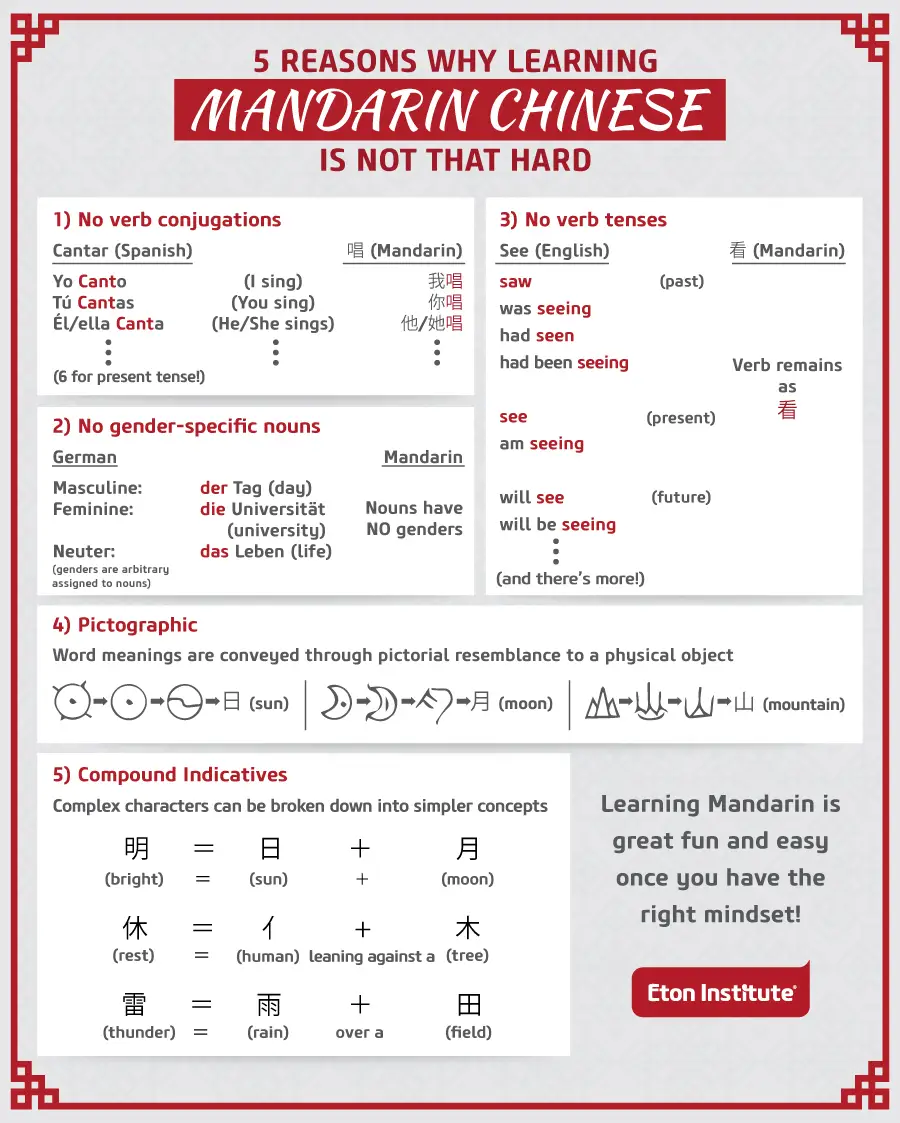
1. No Verb Conjugations — One Form Does Everything
In Spanish, the verb “cantar” (to sing) changes six different ways in the present tense alone — canto, cantas, canta, cantamos, cantáis, cantan. In French it is even more complex. In Mandarin Chinese? The verb stays exactly the same regardless of who is doing the action. 唱 (chàng) means “sing” — and whether it is I, you, he, she or they doing the singing, the verb never changes. For anyone who has struggled with verb conjugation tables in other languages, this is genuinely liberating.
2. No Gender-Specific Nouns — Zero Memorisation Required
German learners spend months memorising whether a noun is masculine (der), feminine (die) or neuter (das) — and the assignments are largely arbitrary. The word for “girl” in German is neuter. The word for “bridge” is feminine. There is no logic to learn — just endless memorisation. Mandarin Chinese has none of this. Nouns have no gender whatsoever. You simply learn the word — and that is all there is to it.
3. No Verb Tenses — Context Does the Work
English has dozens of verb tenses — past simple, past continuous, past perfect, past perfect continuous, and that is just the past. Mandarin Chinese has none of them. The verb 看 (kàn) means “see” — and it stays as 看 whether you saw something yesterday, are seeing something now or will see something tomorrow. Instead of changing the verb, Mandarin uses simple time words — yesterday, tomorrow, last week — to convey when something happened. Once you grasp this, entire conversations open up very quickly.
4. Pictographic Characters — More Logical Than They Look
The writing system is the part that frightens most people — and understandably so. But Mandarin characters are far more logical than they appear at first glance. Many characters are pictographic — meaning they evolved from drawings of the objects they represent. The character 日 looks like the sun. 月 looks like the moon. 山 looks like a mountain. Once you start seeing the visual logic behind the characters, recognition becomes pattern-matching rather than pure memorisation.
5. Compound Indicatives — Complex Characters Made Simple
Here is where it gets genuinely fascinating. Many complex Mandarin characters are built by combining simpler ones — and the combination almost always makes logical sense. 明 (bright) is made up of 日 (sun) and 月 (moon) — because what is brighter than the sun and moon together? 休 (rest) combines 亻(human) and 木 (tree) — a person leaning against a tree. 雷 (thunder) combines 雨 (rain) and 田 (field) — rain over a field. Rather than random symbols, you are reading a visual language that tells a story. This makes vocabulary building far more intuitive than in almost any other language.
So Where Do You Start?
Understanding why Mandarin is not as hard as its reputation suggests is the first step. The second step is finding the right learning environment — one where native-speaking instructors guide you through the tones, characters and vocabulary in a structured, enjoyable way.
Not sure what level you are at? Take our free Mandarin Chinese placement test in Dubai — 75 questions, instant results, no commitment needed. It takes 20 minutes and tells you exactly where to start.
Start Learning Mandarin Chinese in Dubai & Abu Dhabi
At Eton Institute — the UAE’s only EAQUALS-accredited language institute — our Mandarin Chinese courses in Dubai and Abu Dhabi are designed to get you speaking from the very first lesson. Whether you are a complete beginner starting at A0 or looking to build on existing knowledge, we have a course that fits your level, your schedule and your goals.
Choose from:
- Group classes — in-person at our Dubai and Abu Dhabi centres
- Private lessons — one-on-one sessions tailored entirely to your pace
- Live online classes — learn from anywhere with real-time instruction
With over 200,000 successful students and 1,000+ five-star reviews, thousands of learners across the UAE have already discovered that learning Mandarin Chinese in Dubai is not only achievable — it is one of the most rewarding things they have ever done.